
Chapter 5 Nuclear Fusion
5.1 Introduction
For more than half a century governments around the world have been trying to solve the challenge of nuclear fusion. The binding energy per nucleon reaches a maximum near , suggesting that we can also extract energy by fusing two light nuclei into a heavier one. In theory it could provide a cheap, clean, and almost boundless source of energy. The light nuclei are plentiful, and the end products are usually light, stable nuclei, rather than radioactive ones. But smashing two hydrogen atoms together at K to create a fusion reaction has proved to be a costly and (as yet) elusive endeavour – there is one major disadvantage, the need to overcome a strong Coulomb barrier.
Example 5.1.1 (Fusion Example).
Consider the fusion of two 20Ne nuclei to form 40Ca. The energy released 20.7 MeV, or 0.5 MeVnucleon, is comparable to the energy released in fission. However, to get the Ne nuclei close enough so their nuclear distributions begin to overlap requires an electrostatic potential of MeV, and this must be supplied in the form of kinetic energy of the nuclei. Certainly, heavy ion accelerators can achieve this, but typically beam currents are low ( nA - A) and at a current of 1 A, with every particle undergoing fusion (extremely unlikely) the power output would be 2W! An alternative is to heat Ne gas to the point that the thermal energy provides the kinetic energy (the mean kinetic energy per molecule is ). This is known as thermo-nuclear fusion, and we can easily calculate the temperature required to achieve it. For 20Ne it is roughly K.
Generating power from fusion will therefore be a challenge!
5.2 Fusion in the Sun
In the Sun the dominant process by which hydrogen converts to helium is the proton-proton chain reaction. This first step is
| (5.1) |
which produces deuterium (), an isotope of hydrogen. This step is very slow as it involves an energetically unfavourable beta decay. The deuterium produced can then fuse with another proton to form a light isotope of helium,
| (5.2) |
From here there are 4 possible paths to produce , called p-p I, II, III, and IV. p-p I accounts for the majority of the luminosity produced by the Sun, and involves the fusion of two nuclei
| (5.3) |
5.3 Controlled fusion
The most common fuels considered for fusion power on Earth are deuterium () and tritium (), both isotopes of hydrogen. These undergo the following fusion reactions. For deuterium-deuterium (or D-D) reactions there are 2 possibilities
| (5.4) |
For deuterium-tritium (or D-T) reactions the only possibility is
| (5.5) |
These energies are of order 10 MeV per reaction, compared to 100’s MeV for fission. However, because of the density effect the energy output per gram from fusion is greater than for fission. Notice the more stable the end product, the greater the energy release. To cause fusion we have to bring the two positively charged nuclei into close contact. We do not have to climb all the way over the Coulomb barrier, as tunnelling comes into play, but we do have to get to where the barrier is sufficiently narrow.
5.4 Cross-sections
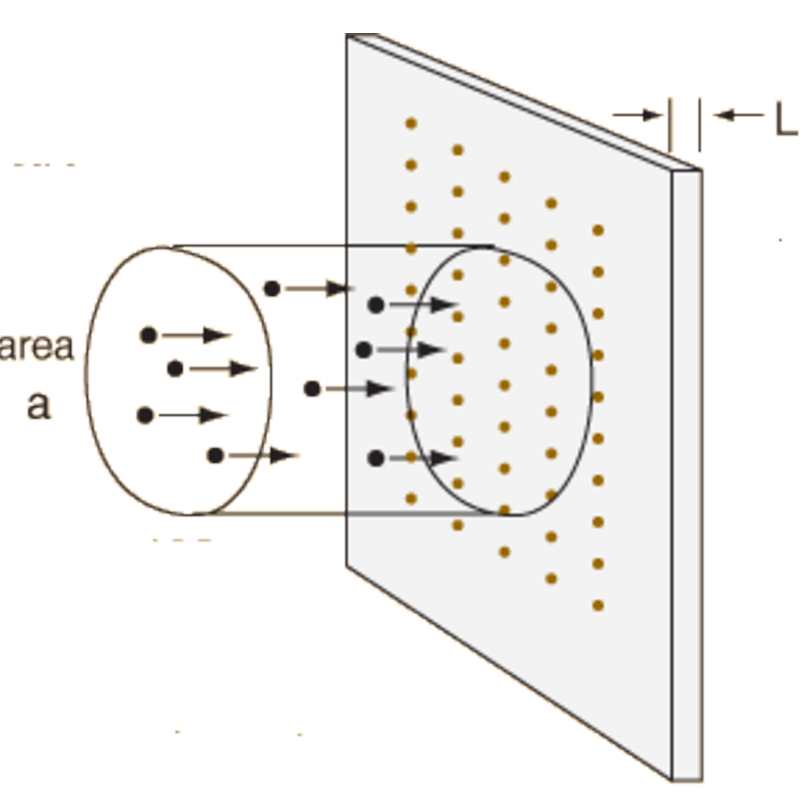
The cross-section is the probability for a reaction/scattering event to occur (for scattering processes see the next lecture). For example, when an incident beam traverses a target some of the particles may be scattered from their original direction by interaction with nuclei in the target.
Definition 5.4.1 (Cross-section).
The probability that an incident particle is scattered is proportional to , the number of target particles per unit area , as shown in Fig. 5.1.
Each target (represented by a black dot) presents a cross-sectional area to an incident beam of particles. The probability of an interaction is then the total cross-sectional area divided by the area,
| (5.6) |
is an area because probability must be dimensionless and has units area-1. Cross-sections are usually measured in barns (b), where 1 barn .
Fig. 5.2 shows the fusion cross-sections for the D-D and D-T fusion reactions. Clearly the D-T reaction is the most favourable and this is the one chosen for controlled fusion reactions.
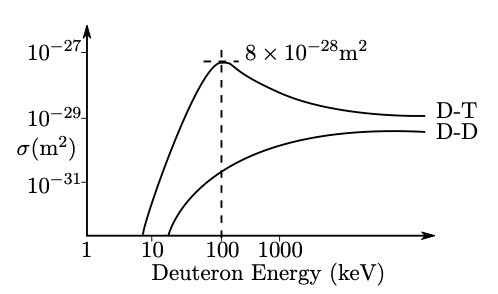
Difficult 5.4.1.
It is useful to visualise the cross-section as a geometric area. The interaction cross-section need not be the same as the geometric cross-section measured by other means, as shown in Fig. 5.3. It should be stressed that the cross-section is a representation of a probability of a process, it is NOT a real area with a precise boundary and may not bear any close physical relationship with the physical size of the scattering particle. For example, a typical nucleus of radius 6 fm has a geometrical area of around 1b. However, neutron capture processes may be of order b.

5.4.1 Relation to reaction rate
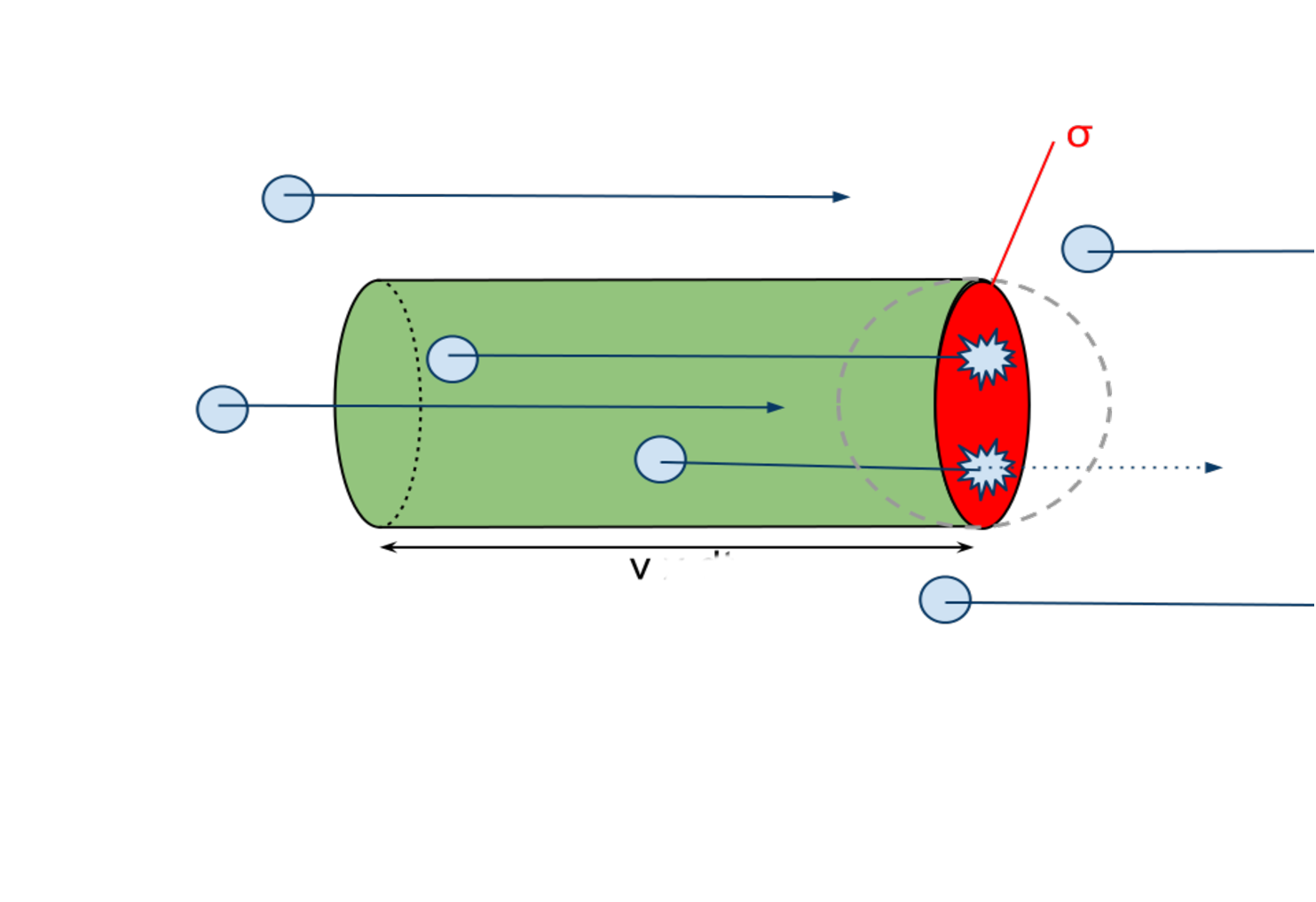
Suppose we have a single target with cross-section , as shown in Fig. 5.4. A beam of particles with number density and velocity is incident on the target. In unit time the available volume of incident particles which could interact with the target is . The number of incident particles which interact with the target in unit time is then given by the reaction rate
| (5.7) |
If there are targets per volume, the total reaction rate per unit volume is
| (5.8) |
5.5 Conditions for fusion
To achieve a deuteron energy of 100 keV requires a temperature of K (hotter than the temperature of the Sun!). The electron binding energies are typically 10 keV so collisions quickly strip off the electrons to give a plasma; a completely ionized gas of nuclei and free electrons.
For fusion to be a source of energy we require energy output energy input. The energy released per unit volume from fusion is
| (5.9) |
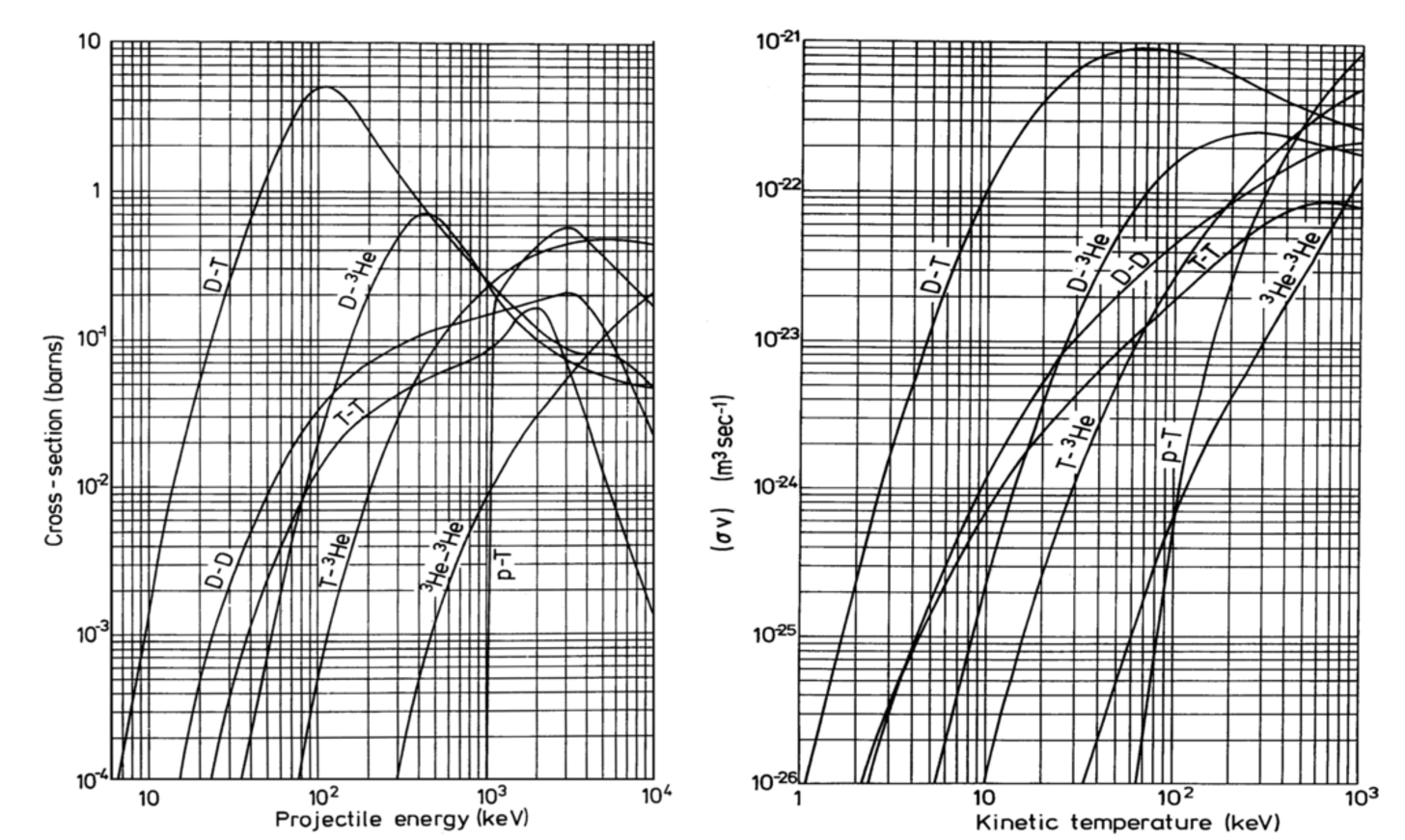
where and are the densities of the two kinds of ions, is the relative velocity of the ions, is the cross-section of fusion, is the containment time and the energy output per reaction. The angled brackets denote the average, since there is a distribution of particle speeds given by the Maxwell-Boltzmann distribution,
| (5.10) |
where is the particle speed, the particle mass and the temperature of the plasma. The product is shown in Fig. 5.5.
If we assume for simplicity (where and are different types of ion, both with a number density equal to half the total number density), then
| (5.11) |
Careful 5.5.1.
The energy out from fusion is
| (5.12) |
when there are two types of ion (e.g. in D-T). When the ions are the same (e.g. D-D) then . This gives
| (5.13) |
where the factor of 2 in the denominator is to avoid double-counting pairs of incident and target ions.
The energy input per unit volume is the thermal energy of the plasma,
| (5.14) |
where the first term is for the ions in the plasma and the second term for the electrons. Assuming the condition for fusion to generate energy is thus:
| (5.15) |
This estimate of the minimum product of ion density and confinement time is known as the Lawson criterion.
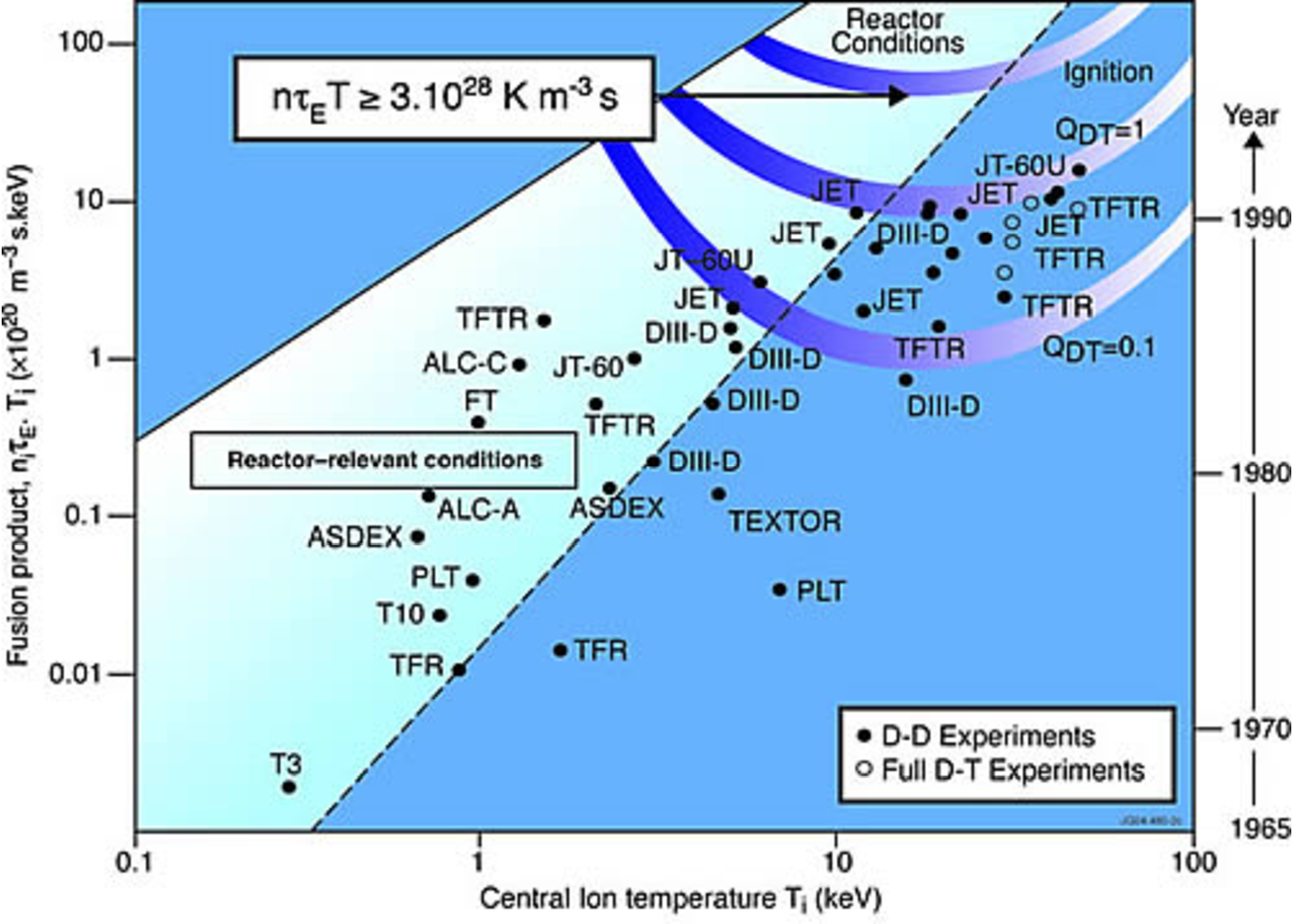
The Lawson criteria gives the break-even condition (fusion power generated equal to power needed to maintain plasma temperature). However, due to losses such as radiation, even at this point energy has to be supplied to maintain plasma temperature. The ignition point is when fusion power generated can maintain the reactor with no external energy source. It is around an order of magnitude larger than the break-even condition. We are still someway off achieving this, as shown in Fig. 5.6. Current reactors have achieved slightly less than break-even.
Example 5.5.1 (Lawson Criteria).
Calculate the Lawson criteria for the D-T reaction at keV, for which . Do the same for the D-D reaction at keV, for which . Comment on your result.
Solution.
Consider the D-T reaction with MeV. At keV then . This gives a condition of
| (5.16) |
For the D-D reaction Bremsstrahlung radiation losses means that the reaction must operate at keV. At these energies then . This gives (taking MeV)
| (5.17) |
A factor of around 100 increase is required in the product of the ion density and confinement time.
5.6 Fusion reactors
How can we generate a plasma at sufficiently high temperature and contain it for sufficiently long to meet the Lawson criterion? There are two approaches to fusion:
-
1.
Increase the confinement time. Because the plasma (ions and electrons) are charged, we can use a uniform magnetic field around which the particles will spiral. If we arrange the field as toroid we can confine the plasma. However, the field inside the toroid will not be uniform over the cross-section (because the windings used to generate it are closer on the inner radius) and the plasma would move in the field gradient, hitting the walls. We can rectify this with an axial current or (better) by passing a current through the plasma itself (Fig. 5.7). This also helps to heat the plasma. This configuration was developed by Russian physicists.
Known as the Tokomak, it was developed intensely in the 1960’s and remains the basis of designs in use today. The most powerful fusion reactor in use today is JET (Joint European Torus) at Culham. It falls short of the Lawson criterion by a factor 6. An international project, ITER, is underway in southern France (45 km N of Aix en Provence) designed to deliver 500 MW of power when it is completed in 2025.
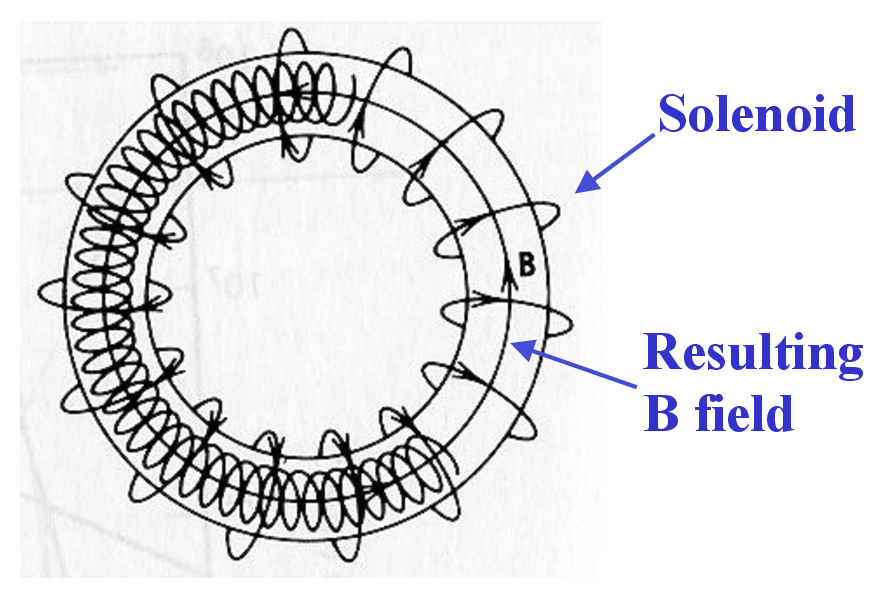
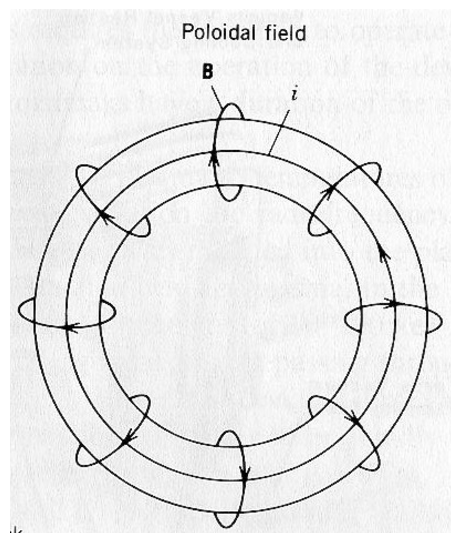
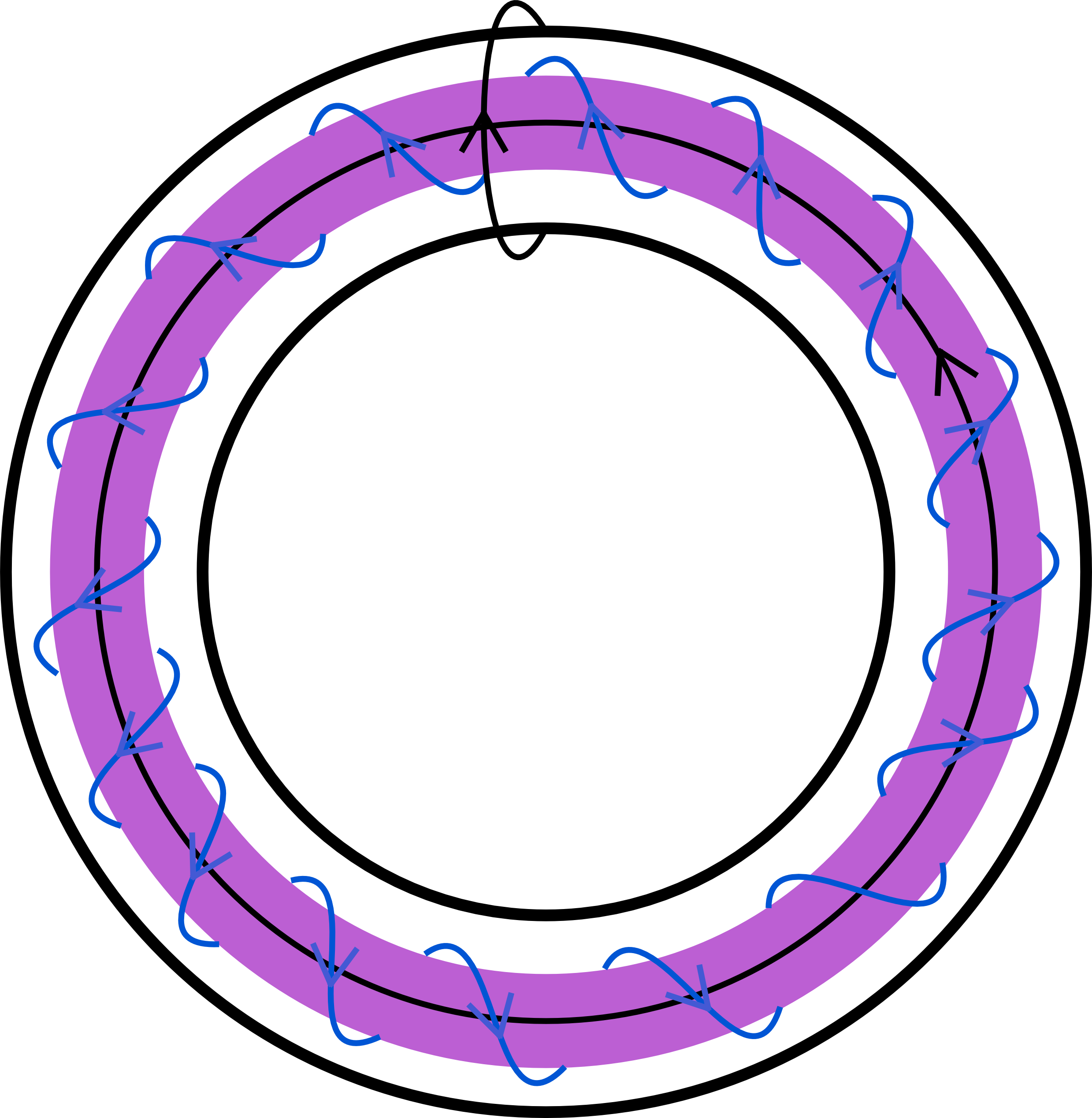
Figure 5.7: Principle of the ‘Tokomak’. -
2.
Increase the density of the plasma. This method is called Inertial Confinement Fusion, or ICF. X-ray radiation heats up a D-T fuel pellet, forming a surrounding plasma envelope. The surface material is blown off and the interior implodes, reaching much higher densities and temperatures. Thermonuclear burn then spreads throughout the pellet, caused by the kinetic energy of the -particles which are produced. Breakeven between input X-ray and output energy has recently been reached at the National Ignition Facility (NIF) in the US. However, lasers are used to produce the X-rays and the input laser energy is still far above the output energy (1.8 MJ compared to 14 kJ).
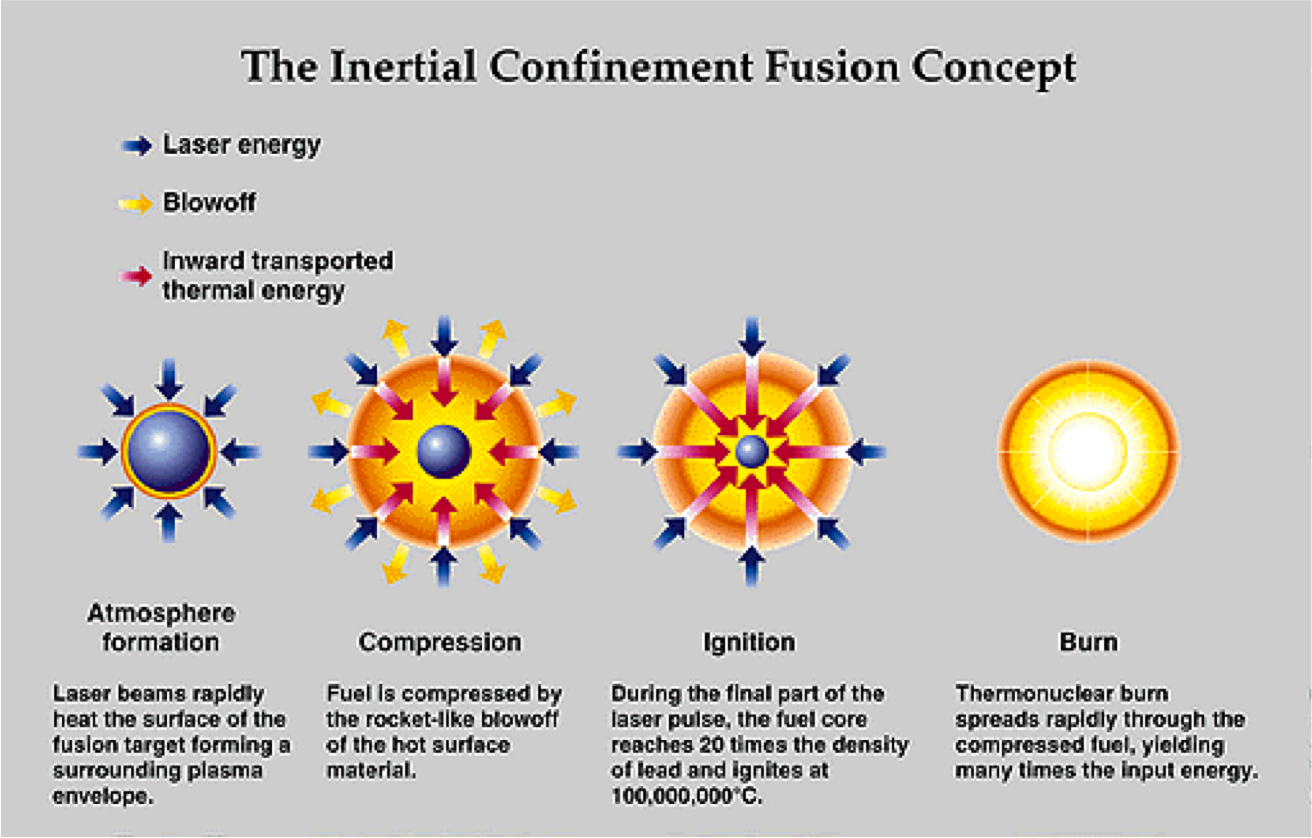
Figure 5.8: Principle of inertial confinement.
5.7 Exercises
Example 5.7.1.
Calculate the temperature required to overcome the Coulomb barrier for a gas of .
Solution.
The Coulomb potential energy is
The nuclear radius is and the thermal energy of the gas is . Assuming and fusion occurs when the nuclei are just touching (so that ), the temperature is given by
Plugging in numbers
This gives a temperature of !